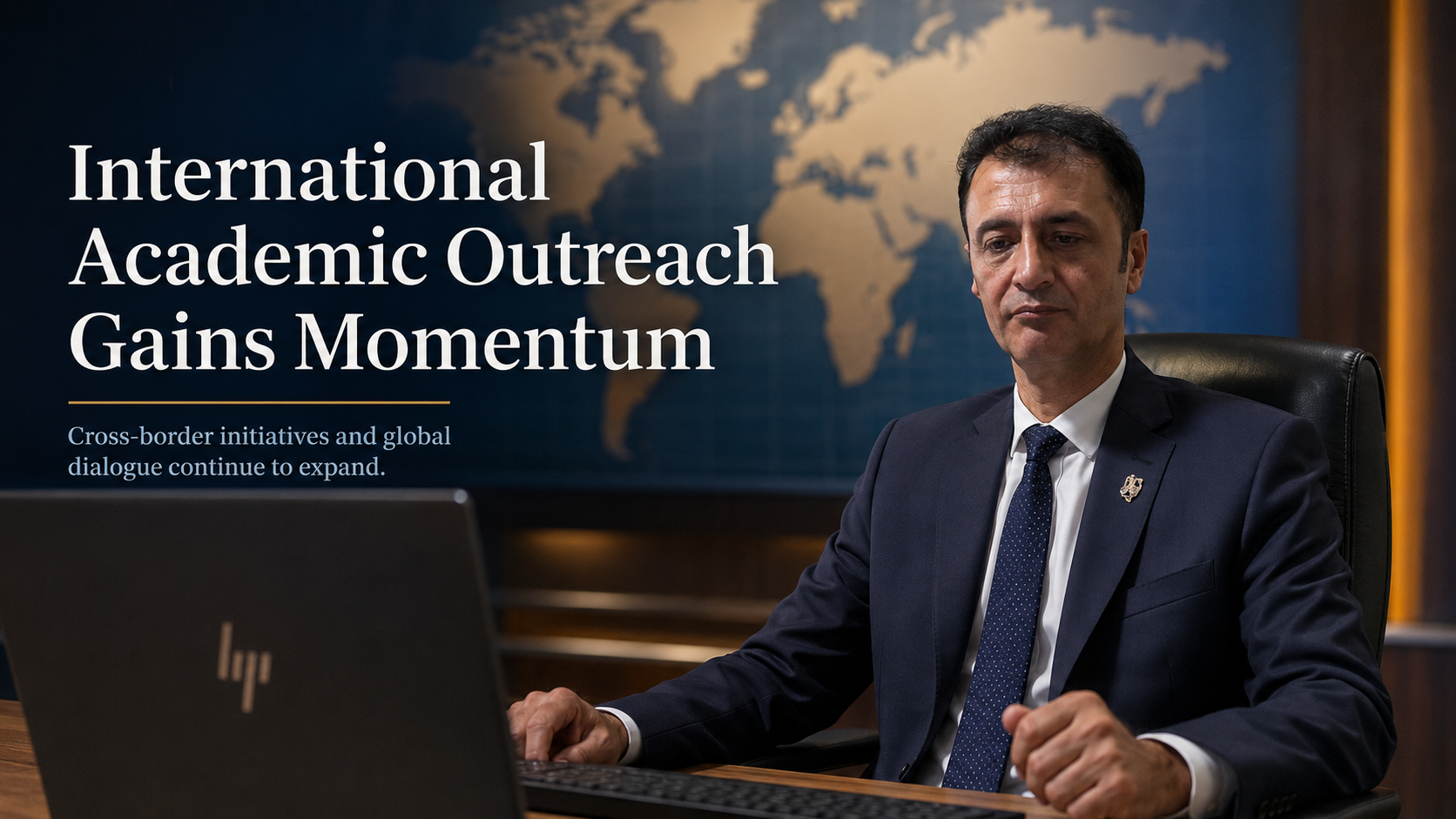
Cross-border partnerships, institutional dialogue and new models of international academic cooperation are entering a more structured and ambitious phase under the strategic direction of Prof. Dr. Bilal Semih Bozdemir.
International academic outreach is gaining new momentum as universities, research institutions, education providers and scholarly networks search for more flexible and sustainable ways to collaborate across national borders.
At the centre of this developing initiative is a broad international engagement strategy led by Prof. Dr. Bilal Semih Bozdemir. The strategy is designed to establish meaningful institutional relationships in areas ranging from university partnerships and joint academic programmes to student mobility, research cooperation, digital education and international academic publishing.
Rather than limiting the process to ceremonial agreements or general declarations of goodwill, the initiative focuses on building relationships that can ultimately produce measurable academic outcomes.
These may include structured progression routes, credit-transfer arrangements, articulation agreements, joint and dual-degree programmes, visiting faculty opportunities, collaborative research projects, international conferences and academic publication partnerships.
The objective is not simply to increase the number of institutions contacted. It is to identify suitable partners, understand their academic and regulatory structures and develop forms of cooperation that respond to the real needs of students, academics and participating institutions.
A changing international education environment
Higher education is undergoing one of the most significant periods of transformation in its modern history.
Students increasingly expect universities to provide international experience, flexible learning pathways and qualifications that can support careers beyond a single national market. Academic institutions, meanwhile, are seeking new ways to expand their international reach, diversify their student populations and participate more actively in global knowledge production.
Digital learning has accelerated this transformation. A student no longer needs to be physically present on a foreign campus throughout an entire programme to benefit from international teaching, academic supervision or collaborative research.
Universities can now deliver joint modules, guest lectures, research seminars and professional development programmes across multiple countries. International classrooms can be created through digital platforms, allowing students and academics from different regions to work together without the financial and logistical burden of permanent relocation.
However, technological access alone does not create a credible international academic programme.
Successful cooperation requires institutional verification, curriculum comparison, quality assurance, academic governance, transparent student information and a clear understanding of the legal authority under which each programme operates.
The international outreach strategy being developed under Prof. Dr. Bilal Semih Bozdemir therefore places equal emphasis on opportunity and institutional responsibility.
Beyond ceremonial agreements
Many international academic agreements begin with enthusiasm but produce limited practical results. Memoranda are signed, photographs are taken and broad intentions are announced, yet students and academic staff may never see a meaningful benefit.
The emerging outreach model seeks to move beyond this pattern.
Each proposed collaboration must be assessed according to what it can realistically deliver. A potential partnership should answer practical questions: Can students transfer credits? Can academics work on joint research? Can institutions develop a shared programme? Are the qualifications and academic authorities clearly defined? Is there a functioning mechanism for communication, supervision and quality control?
A productive agreement may begin on a relatively modest scale.
Two institutions could first organise a joint webinar, an academic conference or a short professional certificate programme. They could then move toward faculty exchange, collaborative research or a formal progression agreement. Only after academic compatibility and institutional trust have been demonstrated would a more complex joint or dual-degree structure be considered.
This gradual approach reduces risk and allows the participating institutions to develop cooperation on the basis of actual experience rather than expectations alone.
University partnership opportunities
The international academic outreach initiative examines several forms of institutional cooperation.
One of the most accessible models is a general academic cooperation agreement. This provides a framework for universities to organise academic meetings, share expertise, invite guest lecturers and explore future projects.
A more advanced option is an articulation agreement. Under this model, students complete a defined part of their education at one institution and continue the remainder at another, provided that the previously completed courses meet the receiving institution’s academic requirements.
Progression agreements serve a similar purpose. They create a recognised route through which graduates of one programme may enter a higher-level programme at a partner institution.
Credit-transfer arrangements allow students to carry eligible academic credits from one institution to another. These agreements require careful evaluation of course content, learning outcomes, assessment standards and the number of credits awarded.
Joint-degree and dual-degree programmes represent the most complex forms of cooperation. They may involve shared curriculum design, coordinated teaching, joint assessment and clearly defined graduation requirements.
Because terminology and legal structures differ between countries, each proposed programme must be evaluated independently. A programme described as a joint degree in one jurisdiction may have a different legal meaning in another.
For this reason, international academic outreach must be based on careful documentation rather than assumptions.
Student interests at the centre of cooperation
The true value of an international partnership should be measured by the opportunities it creates for students.
A successful programme can allow students to study with academics from different countries, gain access to specialised modules, experience different educational systems and develop the intercultural skills increasingly required in professional life.
Students may also benefit from broader academic networks. Participation in an international research project, conference or publication can strengthen a student’s academic profile and create opportunities for further study or professional development.
At the same time, international programmes can expose students to risks when information is unclear.
Students must know which institution is providing the education, which institution is issuing the qualification, whether credits are transferable, what the total financial commitment will be and which recognition procedures may apply in the country where they intend to use their qualification.
An institution may be legally authorised in its home jurisdiction while recognition in another country remains subject to a separate evaluation by the relevant national authority.
This distinction must be communicated openly.
The developing outreach model therefore places strong emphasis on transparent programme descriptions, written academic requirements, clearly identified institutional responsibilities and realistic statements concerning recognition.
Academic quality cannot be compromised
International expansion must not come at the expense of academic quality.
Every proposed partnership should involve a serious comparison of curricula. Course titles alone are not sufficient. Institutions need to examine learning outcomes, teaching hours, assessment methods, research requirements, practical components and academic level.
In regulated or professionally sensitive fields, the process becomes even more important. Programmes related to health, psychology, law, engineering, education and other regulated professions may be subject to national licensing or professional recognition requirements.
An academic degree does not automatically provide professional practice rights in every country.
This means that cooperation agreements must clearly distinguish between academic qualification and professional authorisation.
Quality assurance must also cover student admission, identity verification, examination security, plagiarism prevention, academic integrity and the appointment of appropriately qualified teaching staff.
In digital and blended-learning programmes, institutions must additionally ensure that students receive genuine academic interaction, supervision and access to learning resources.
International academic cooperation becomes sustainable only when partner institutions are prepared to protect the credibility of the programmes carrying their names.
Research collaboration as a core priority
Teaching partnerships represent only one part of the international academic outreach agenda. Research cooperation is another central priority.
Many of today’s most significant challenges cannot be adequately examined within the borders of a single country.
Public health, mental well-being, climate change, migration, digital transformation, cultural heritage, mining, sustainable development, international law and regional security all require multidisciplinary and cross-border perspectives.
International research partnerships make it possible to compare data from different societies, combine specialised expertise and examine how the same issue develops under different legal, cultural and economic conditions.
The outreach strategy encourages the formation of thematic academic groups in which researchers from several institutions can work on a common subject.
Such cooperation may lead to joint research proposals, comparative studies, edited academic volumes, conference panels and peer-reviewed publications.
Young academics and postgraduate students should also be included in these networks. International research should not remain limited to senior institutional representatives. It should create opportunities for emerging scholars to gain experience, develop publication skills and establish professional relationships.
Academic publishing and global visibility
International academic publishing is another area in which cooperation can produce substantial benefits.
A journal with authors, reviewers and editors from different countries can achieve greater intellectual diversity and a broader international readership. Institutions may cooperate on special issues, conference proceedings, research reports and interdisciplinary publication projects.
However, international visibility must not be pursued through quantity alone.
Credible academic publishing requires editorial independence, transparent peer review, plagiarism screening, publication ethics and clearly stated authorship standards.
The international outreach initiative therefore treats academic publishing as an area requiring both expansion and strong ethical oversight.
Partnerships between journals, universities and research centres may also help scholars whose work is currently underrepresented in international academic databases. Researchers from smaller institutions or emerging academic regions often produce valuable work but face difficulties in reaching a global audience.
A responsible international publishing network can help address this imbalance without weakening academic standards.
Academic diplomacy and international dialogue
Academic cooperation also has a diplomatic dimension.
Universities can maintain dialogue even when political relationships are difficult or formal diplomatic channels are limited. Students, researchers and academic leaders can create long-term connections based on knowledge, professional respect and shared intellectual interests.
This form of engagement is often described as academic diplomacy.
Academic diplomacy does not replace state diplomacy. Its role is different. It creates relationships between institutions and individuals that may survive political change and contribute to broader mutual understanding.
A joint research project, student exchange or academic conference may bring together participants from countries with very different political and cultural backgrounds. Through sustained cooperation, these participants develop professional trust and a more nuanced understanding of one another’s societies.
Prof. Dr. Bilal Semih Bozdemir’s international engagement strategy considers academic dialogue an important element of wider international cooperation.
The focus includes Europe, the Caucasus, the Middle East, Africa, South Asia and other regions where institutions may benefit from carefully designed cross-border partnerships.
Because every region has its own educational priorities, the approach does not depend on a single standardised model. Cooperation must be adapted to the circumstances, authority and academic capacity of each potential partner.
Digital infrastructure for global outreach
A global academic initiative requires more than correspondence and occasional meetings.
When hundreds or potentially thousands of institutions are being evaluated, the process must be supported by organised digital infrastructure.
Institutional contact information, areas of academic interest, regulatory status, correspondence records and meeting outcomes all need to be documented. Without a structured system, valuable contacts can be lost, repeated messages may be sent and institutional knowledge may remain dependent on individual email accounts.
Digital outreach systems can support the identification of relevant universities, international offices, research centres and authorised institutional representatives.
They can also help categorise institutions according to country, academic field, partnership model and level of priority.
Automation can assist with repetitive administrative processes, but it cannot replace academic judgement.
A system may identify a university that publicly expresses interest in international partnerships. Human review is still required to determine whether the institution is properly authorised, whether its programmes are academically compatible and whether the proposed cooperation is suitable.
Technology should therefore function as an organisational instrument rather than an automatic decision-maker.
Institutional verification and due diligence
The credibility of an international academic network depends heavily on the quality of its partners.
Before formal engagement, institutions should be evaluated through official sources. Their legal status, national authorisation, accreditation position, programme approval and physical or digital infrastructure should be examined.
The use of an official-looking website is not sufficient evidence of academic authority.
Verification may involve checking national education ministry records, accreditation bodies, university registers, official institutional documents and the information published by recognised quality-assurance organisations.
The same level of care should be applied to individuals claiming to represent an institution. Important proposals should be communicated through verifiable institutional email addresses and confirmed by authorised officials.
Due diligence protects all parties. It reduces the risk of reputational harm, protects students from misleading programmes and ensures that institutional resources are directed toward genuine opportunities.
The international outreach programme is therefore designed to prioritise verified institutions and clearly documented channels of communication.
A multi-stage model for international engagement
The developing strategy follows a staged process.
The first stage is research. Potential partners are identified according to their institutional status, academic programmes, geographical relevance and publicly expressed interest in international cooperation.
The second stage is initial contact. A concise institutional proposal is directed to the appropriate office, which may be an international relations department, partnership office, rectorate, academic faculty or admissions unit.
The third stage is dialogue. Institutions that express interest are invited to clarify their priorities, available programmes, regulatory limitations and preferred forms of cooperation.
The fourth stage is academic and institutional assessment. Curricula, programme structures, legal authorities and quality-assurance arrangements are reviewed.
The fifth stage is project design. The parties define responsibilities, academic requirements, student protections, financial arrangements and implementation procedures.
Only after these stages have been completed should a formal agreement be finalised.
This structure helps distinguish genuine partnership development from indiscriminate mass communication.
Opportunities for multidisciplinary cooperation
The international outreach initiative is not limited to a single academic discipline.
Health sciences, psychology, law, international relations, engineering, mining, environmental studies, business, communication, cultural heritage and digital technologies all offer possibilities for international collaboration.
Multidisciplinary cooperation is especially valuable where a subject cannot be understood through one field alone.
For example, a project concerning mining may involve engineering, environmental science, occupational health, economics, international trade and community development.
A mental-health initiative may require psychology, medicine, sociology, education, digital technology and public policy.
A cultural heritage project may combine history, archaeology, museum studies, tourism, law and digital archiving.
By connecting academics from different disciplines and countries, international outreach can produce more comprehensive and socially relevant research.
Supporting institutions with limited international capacity
Not every university has a large international office or the resources to maintain a global network.
Smaller and regional institutions may have qualified academics and valuable programmes but limited visibility outside their own countries. They may struggle to identify suitable partners or prepare international cooperation proposals.
A structured academic network can help these institutions participate in global projects without requiring them to build a large international administration from the beginning.
Cooperation might start with a single faculty, a joint conference or a guest lecture series. As trust develops, the relationship may expand into student mobility, research collaboration or a formal programme.
This approach can make internationalisation more inclusive. Global academic cooperation should not remain the exclusive domain of a small number of wealthy and internationally famous universities.
Transparency as a long-term institutional asset
Trust is one of the most valuable assets in international education.
Students and partner institutions need accurate information, timely communication and written confirmation of important commitments.
Fees, programme duration, assessment requirements, diploma arrangements and refund conditions should be explained before enrolment. Institutions should avoid presenting proposed agreements as completed partnerships or describing qualifications in a way that could create unrealistic expectations.
Transparency may initially appear to slow expansion. In reality, it protects institutions from future disputes and builds the credibility necessary for sustainable growth.
A smaller number of well-structured partnerships is more valuable than a large collection of inactive or unclear agreements.
The international academic outreach strategy therefore emphasises documentation, institutional accountability and precise public communication.
The next phase
The next phase of the initiative is expected to involve more focused engagement with universities and academic institutions that have demonstrated a genuine interest in international partnership models.
Priority may be given to institutions that offer clear procedures for academic cooperation, maintain functioning international offices and have programmes that are compatible with cross-border delivery or student progression.
Online institutional meetings can be used to identify common priorities before either party commits substantial time or resources.
Early-stage projects may include international seminars, guest lectures, academic advisory boards, short certificate programmes, collaborative publications and research workshops.
More complex arrangements, including formal articulation or dual-degree programmes, can then be developed where the academic, legal and institutional conditions are appropriate.
The success of this process will depend not on the speed with which agreements are announced, but on the quality of the relationships established.
Building a durable global academic network
International academic outreach is ultimately about creating a durable network of institutions and individuals who are prepared to share knowledge, resources and responsibility.
Such a network may include universities, research centres, scholarly journals, museums, professional organisations, educational technology providers and civil-society institutions.
Each organisation can contribute a different form of expertise.
Universities provide academic programmes and qualified faculty. Research centres contribute specialised knowledge. Journals support the dissemination of findings. Museums and cultural institutions connect education with heritage and public engagement. Technology providers make international participation more accessible.
When these elements are connected through credible governance and clear academic objectives, international outreach can become more than an institutional marketing exercise. It can become an infrastructure for education, research and intercultural dialogue.
A broader vision for academic cooperation
The growing momentum behind the initiative reflects a broader vision of higher education.
In this vision, universities do not operate as isolated national institutions. They become participants in an interconnected academic environment where knowledge, talent and educational opportunity can move across borders.
At the same time, internationalisation must not erase institutional identity or national academic standards. Effective cooperation respects the authority, culture and academic traditions of each partner.
The goal is not to create uniformity. It is to create compatibility, dialogue and mutual benefit.
Under the strategic direction of Prof. Dr. Bilal Semih Bozdemir, the international academic outreach process is moving toward a more organised, selective and results-oriented phase.
Its long-term success will be measured by the quality of the programmes developed, the research produced, the opportunities created for students and the level of trust established between institutions.
The central message is increasingly clear: the future of higher education will not be shaped by institutions working alone. It will be shaped by universities and academic communities that are capable of building responsible partnerships, sharing knowledge and responding together to global challenges.
Leave a Reply